cert-manager is the standard tool in the Kubernetes ecosystem for automatically provisioning and managing TLS certificates. cert-manager has a pluggable architecture allowing users to write their own external issuers (i.e. controllers that reconcile and sign CertificateRequests) while integrating with the rest of the cert-manager certificate management lifecycle (e.g. renewals):
apiVersion: cert-manager.io/v1
kind: Certificate
metadata:
  name: example
  namespace: example
spec:
  # Sign certificate using my external issuer
  issuerRef:
    group: example.com
    kind: ExampleIssuer
    name: example
  secretName: example-tls
  dnsNames:
    - example.com
This capability is incredibly powerful in an enterprise environment where many exceptional (and often extraordinary) requirements may exist that cannot be handled by cert-manager’s built-in issuers.
issuer-lib
issuer-lib is a Go library for building cert-manager issuers, built and maintained by the cert-manager maintainers.
By referencing the simple example provided in the library repository and implementing the Check and Sign functions, users can extend the functionality of cert-manager with their own certificate issuing logic.
Example
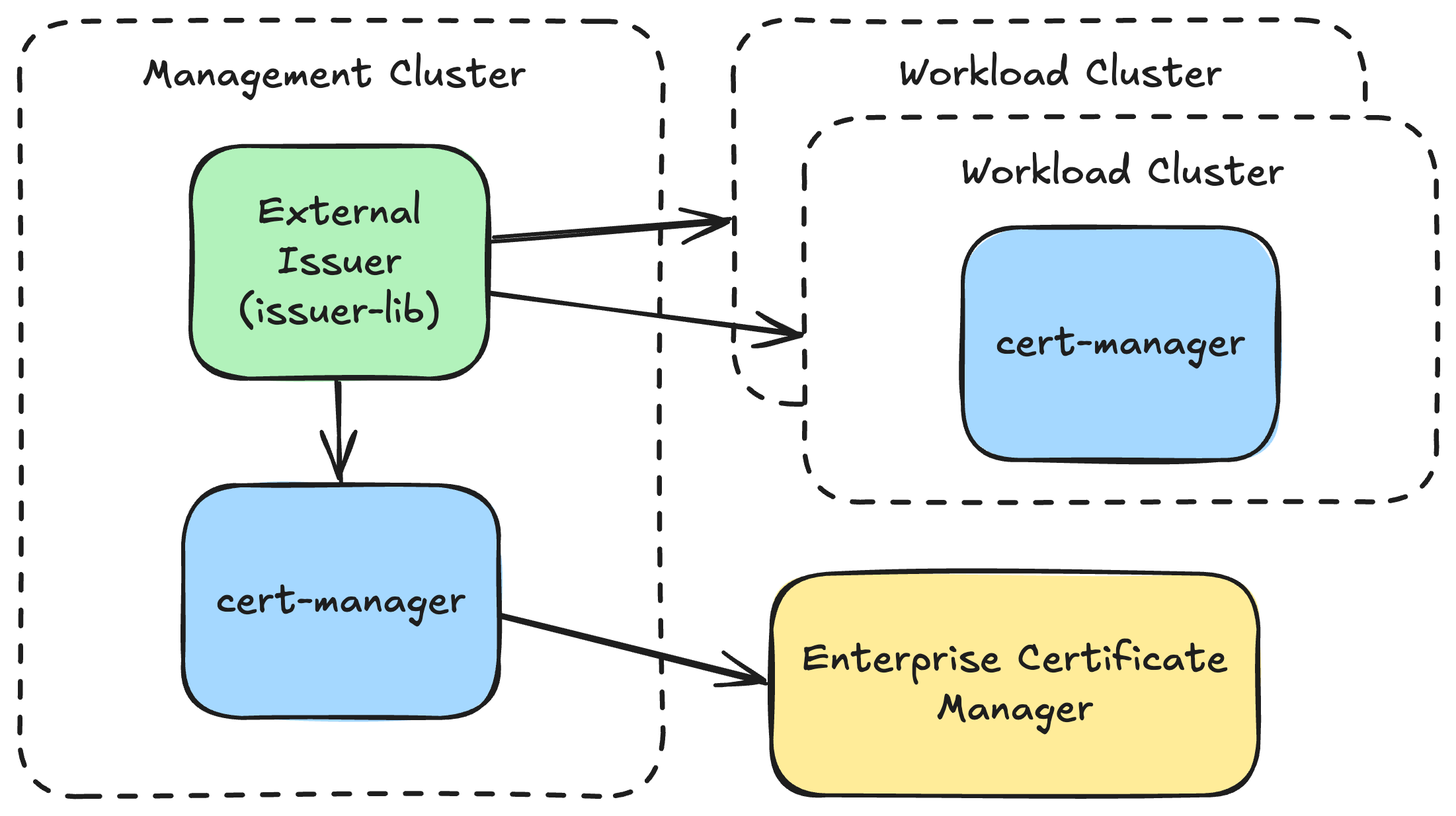
One use of issuer-lib that I have found particularly powerful is running it in a management cluster and signing external issuer CertificateRequests in remote workload clusters by creating a corresponding CertificateRequest in the management cluster.
This allows highly privileged credentials to be stored in the management cluster without exposing them directly to workload clusters. Custom validation can be applied before CertificateRequests are created in the management cluster to restrict the scope of each workload cluster.
In the following diagram, the workload clusters cannot authenticate directly to the enterprise certificate manager; instead, any CertificateRequests created in the workload clusters referencing the external issuer will be picked up and signed by creating a corresponding CertificateRequest in the management cluster. Note that cert-manager still needs to run in the workload clusters to manage the certificate lifecycle: